Most Construction Digital Twins Are Presentations, Not Systems
The Deployment That Doesn't Stick
Every month, a contractor somewhere stands up a digital twin for a major program. There is a kick-off presentation: a rendered BIM model, a drone overlay, a progress dashboard the owner finds impressive. Eight weeks later, the model is three milestones behind the actual work, the drone data hasn't been processed since the kick-off flight, and the PM is back to running off the printed schedule.
The kickoff artifact had the shape of a system, but the project team was still managing it like a presentation.
Where It Actually Breaks
A useful digital twin is a live representation of site state, not a presentation model with progress labels. It has to update fast enough to inform decisions before the window to act has closed. That definition puts the weight where it belongs: on the data architecture, not the rendering engine.
The breakdown on most programs lives at the same failure point: the data contract. Who owns each data stream? What triggers an update? What is the acceptable latency between a physical event on site and its reflection in the model? On most programs, nobody has written answers to those questions before the twin goes live. The drone flies when the operator is available. The BIM model updates when the VDC engineer finds time. As-built records sync when someone remembers to flag scope completion.
The result is a set of individual habits with no ownership, no cadence, and no accountability when the model drifts. Drift usually starts as a governance failure before it becomes a technology problem.
Four Layers That Have to Work Together
A digital twin that functions as a live system has four layers, and the failure mode is different at each one.
The capture layer is cameras, UAVs, and site sensors. This is the part the industry focuses on most, and it is the most mature. Commercially available UAV platforms can survey a 20-acre site in under 45 minutes and produce the point cloud and orthoimage a progress model needs. For most programs, capture is a solved problem.
The processing layer is where most deployments break first. Raw drone imagery doesn't become schedule-ready progress data automatically. It needs a vision model that can classify completed scope, compare it against the planned state, and produce a structured output the PM can act on. For programs relying on manual review, processing a single weekly flight takes 4 to 6 hours. Automated processing runs in under 10 minutes. The programs still on manual review aren't saving money. They are guaranteeing the model is always 3 days stale when a decision actually needs it.
The integration layer is where most deployments break second. Even when processing is automated, the output typically lands in a separate file, on a standalone dashboard, disconnected from the schedule and the RFI log the project team already uses. A twin that requires a tab switch to consult is a twin that won't be consulted under schedule pressure. The output has to push into the existing workflow.
The action layer is where the twin either delivers or documents. A progress deviation flagged 72 hours before the affected activity reaches the critical path is actionable. The same deviation flagged 72 hours after is a post-mortem note. The latency between the physical event and the model update determines which one you have.
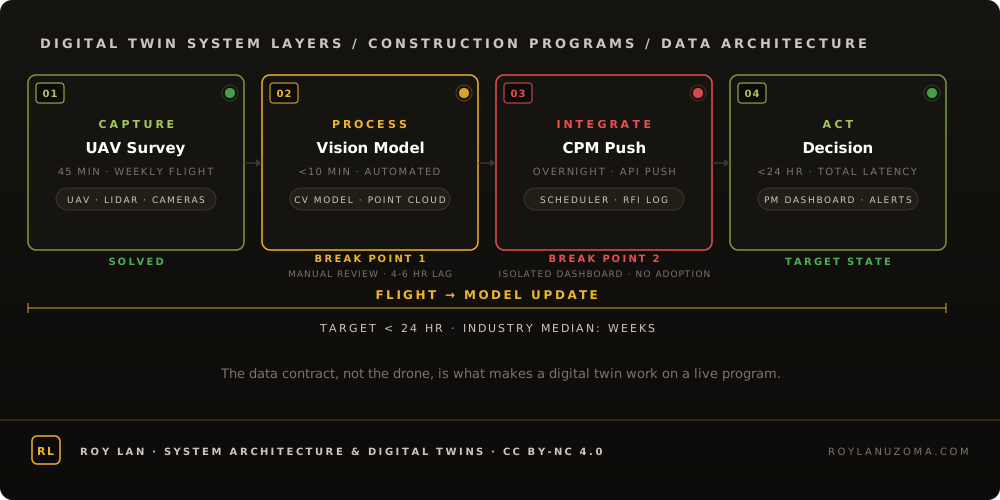
Use the diagnostic below to test whether a digital twin has enough operating discipline behind it to function as a live control system.
What UAVs Actually Contribute
A UAV is a capture layer. Buying the aircraft does not create the data ownership, processing cadence, or schedule integration needed to keep the model current.
What UAVs do well: systematic spatial coverage at a cadence ground surveys can't match, elevation access on structures in progress, and raw data quality that current vision models can process with strong detection confidence. Validated on active construction sites, pose estimation and scope-completion detection hold within reliable thresholds across the variable lighting and partial-occlusion conditions that degrade earlier-generation systems. Current commercial hardware and off-the-shelf vision pipelines can reach this performance level at a per-flight cost that fits a mid-size program's operations budget.
What turns that capture capacity into a live system is the three layers above it. A well-configured processing pipeline turns the week's drone data overnight. A well-designed integration layer pushes the output into the existing CPM tool the next morning. The project team gets an updated model with no manual handoffs between the drone flight and the decision.
The Number That Tells You If It's Working
One metric reflects whether a digital twin is a live system or a presentation layer: the median time between a physical progress event on site and its reflection in the model. On a well-architected system, that number is under 24 hours. On most current deployments, it is measured in weeks.
A useful starting point is a single question to the VDC lead: what is the current median time between a field event and its reflection in the model? If there is no ready answer, that is the diagnostic. The twin has no performance target and no defined owner. If the number is over 72 hours, there is a gap in either the processing pipeline or the integration layer. Both usually come down to ownership, cadence, and integration discipline: a named owner, a written cadence, and the model treated as a control instrument rather than a presentation asset.