Why Standard Ergonomic Tools Fall Short for Workers at Height
What REBA Gets Right, and Where It Stops
The Rapid Entire Body Assessment (REBA) is one of the most widely used ergonomic risk tools in construction safety. It scores posture across major body regions, weights those scores against load and activity level, and produces a risk category that directs intervention decisions. For ground-level work, it does this reliably.
The structural limitation becomes visible as soon as work moves off grade. REBA scores posture. It does not score where the posture occurs. A worker bending forward at 30 degrees to install conduit at ground level and a worker in the same posture on a scaffold 6 meters up receive the same REBA score. The risk is not the same.
Height changes the physiological load of that posture in ways REBA was not designed to capture. Elevated workers maintain increased muscular co-contraction to hold balance on restricted platforms. Proprioception degrades at elevation. A postural lapse at 6 meters carries far greater consequence than the same lapse at grade. Standard ergonomic assessment treats both scenarios as equivalent exposures.
What Height Does to the Body
Two mechanisms distinguish the ergonomic load at elevation from the same posture at grade. The first is biomechanical: the drive to maintain balance demands continuous stabilization from the trunk and lower limbs, regardless of the task itself. Co-contraction of stabilizer muscle groups elevates metabolic cost and joint loading above what the posture score would predict. A moderate-load task at 6 meters produces genuinely higher cumulative loading than the same task at grade, and the score does not reflect it.
The second is behavioral: restricted platform geometry limits repositioning. Ground-level workers interrupt sustained postures with small shifts in stance or reach. At elevation, repositioning requires deliberate weight transfer and carries its own fall-risk consideration. Workers hold positions longer than the task requires, extending static loading beyond what the task itself would demand.
Both mechanisms accumulate over a shift without announcing themselves. The injury report arrives weeks or months after the exposure window has closed.
What Context-Aware Scoring Changes
The problem is not REBA itself. The problem is applying a ground-level assessment tool to conditions that change the load that tool is trying to quantify.
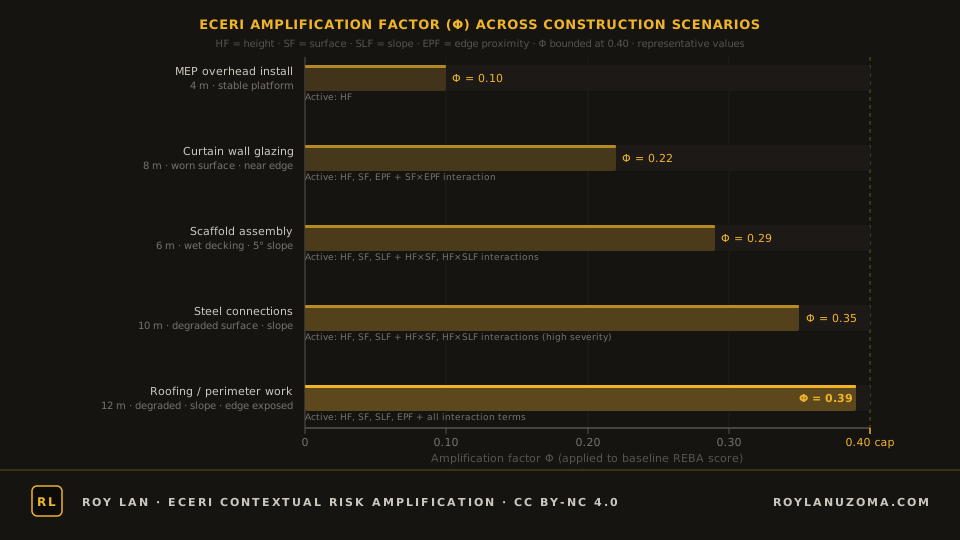
Research published as the Elevated Construction Ergonomic Risk Index (ECERI) in the Journal of Safety Research (Lan and Awolusi, 2026) addressed this directly. ECERI integrates four environmental amplifiers into a bounded adjustment on the baseline REBA score: height, surface condition, slope angle, and edge proximity. The term Φ is bounded within [0, 0.40] by construction, with second-order factor interactions ensuring co-occurring conditions produce amplification no single-input score would predict.
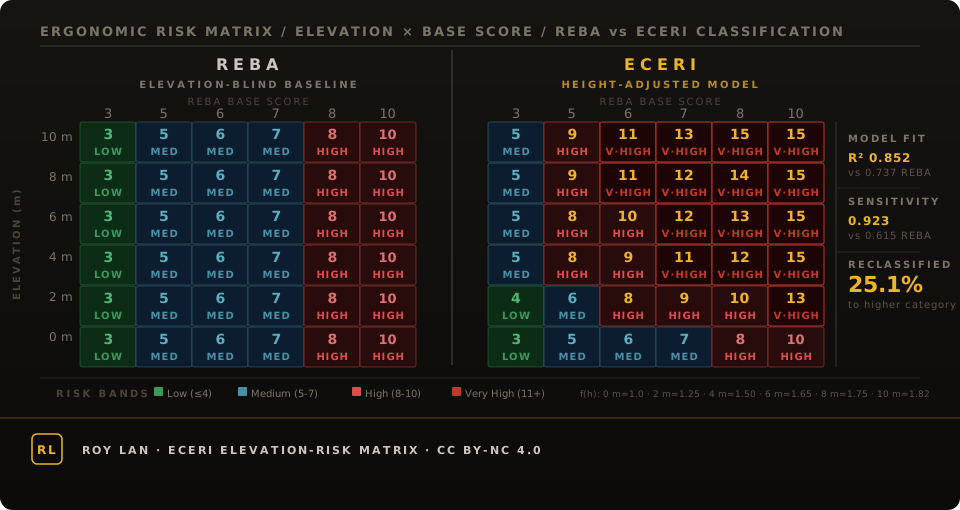
Across a range of simulated elevated task scenarios, applying the height-adjusted index reclassified 25.1 percent of assessments into higher risk categories. Expert-assessed risk alignment improved from R² = 0.737 under REBA alone to R² = 0.852. High-risk detection sensitivity moved from 0.615 to 0.923. That 0.615 figure is the operational problem: a tool that identifies fewer than two thirds of genuinely high-risk elevated tasks is leaving a significant share of the at-risk workforce unclassified.
What tools like ECERI demonstrate is that ergonomic assessment can be made context-sensitive without discarding the practitioner knowledge already embedded in REBA. The base score remains. The height context transforms what it means.
What This Enables When Combined With Other Tools
Context-aware scoring does not need to remain a manual, task-by-task exercise.
Pose estimation systems already deployed on construction sites, through fixed cameras, UAV imagery, or wearable sensors, output posture classifications and REBA-equivalent risk scores in near real-time. Elevation data is already available on most connected programs: BIM model attributes carry floor elevation for every active scope, and GPS altitude logging on wearable devices provides continuous vertical position without any additional sensor. On programs already running real-time posture monitoring, adding elevation as a scoring input requires one additional data field in the same processing pass.
Wearable inertial measurement units now common on safety vests and hard hats for fall-event detection continuously log the wearer's vertical position. Pairing that signal with posture inference from the same device creates a continuous ergonomic exposure record that captures both posture and the elevation at which it occurs. At shift end, the program shows which crews spent the most time in high-risk postures at elevation, broken down by workfront and elevation band, with enough resolution to distinguish exposure patterns by scope type.
Digital twin environments that model active construction programs already map where elevated scope is occurring and when. Integrating a context-aware scoring step into work package release, keyed to the BIM elevation data for that scope, makes the height adjustment a routine part of planning-stage risk review. The project engineer does not need to source the elevation separately. It is already in the model.
As site monitoring infrastructure matures, tools designed around this principle move from planning inputs to continuous operational signals. The same data streams driving schedule tracking, quality documentation, and safety monitoring start returning ergonomic exposure data that reflects the environment workers are operating in.
On a data center program running concurrent MEP installation, curtain wall work, and structural steel connections across three elevation bands, a monitoring system integrating posture classification with elevation tracking produces a shift-end exposure profile showing which crew types, at which heights, are accumulating the most elevation-weighted ergonomic exposure per hour worked. MEP crews at 4 to 6 meters generated the highest overhead-reach exposure per shift. Curtain wall crews at 8 to 10 meters showed the highest static posture duration. Neither pattern was visible from walkthroughs. Both surfaced within the first two weeks of continuous monitoring. When the MEP scaffold configuration was revised to reduce overhead reach angle at the 5-meter work level, the program verified the intervention's effect at the next weekly review because the baseline data existed before the change. Without continuous monitoring, the same verification requires a scheduled before-and-after ergonomic assessment, dependent on which task cycle an assessor happens to observe and whether conditions that day represent the pattern or an exception.
Where to Start
The argument for context-aware ergonomic assessment does not depend on having any of the technology integrations described above. It depends on asking whether the assessment method applied to elevated work was designed with that environment in mind.
For most programs, the productive starting point is the work method statement review for elevated scopes: overhead MEP installation, curtain wall systems, scaffold installation, and structural steel connections. Applying a context-aware scoring step to the highest-risk task cycles in each scope, before the scaffold is built and the crew is mobilized, identifies reclassified exposures while controls can still be designed into the work rather than retrofitted after the crew has already absorbed the load.
Standard ergonomic assessment was built for ground-level conditions. Construction at elevation changes the biomechanical load in ways that are now quantifiable, and the tools to quantify them are operational. Bring that to the next elevated scope review: does the current assessment account for height as a distinct risk input, or does it score an elevated task the same way it scores the same task at grade, regardless of how far up the crew is working?