Heat Stress in Construction Is a Data Problem, Not a Hydration Problem
The Prevention Program Has Not Aged Well
The standard heat-illness prevention model on most construction sites is some variation of water, rest, and shade. Crews are reminded to hydrate. Breaks are scheduled when the heat index crosses a threshold. A safety toolbox talk goes out on the first 95-degree day of the season. Those controls still matter, but they miss the cumulative load building inside the shift.
The Bureau of Labor Statistics records a ten-year average of more than 30 heat-related occupational fatalities per year in U.S. private industry, and construction consistently accounts for the largest share of them. Those numbers do not reflect a program failing in concept. They reflect a program designed for a different kind of jobsite, applied to one that has changed.
OSHA acknowledged the gap in 2022 by launching the National Emphasis Program on Outdoor and Indoor Heat-Related Hazards. The federal heat standard rulemaking is still in progress. The crews working through this summer's heat dome do not have time to wait for it.
Heat does its damage on a delay. The curve below shows what that looks like over a single shift: exposure load building steadily while the worker still feels capable, then crossing the danger line well before any symptom would tell a supervisor to step in.
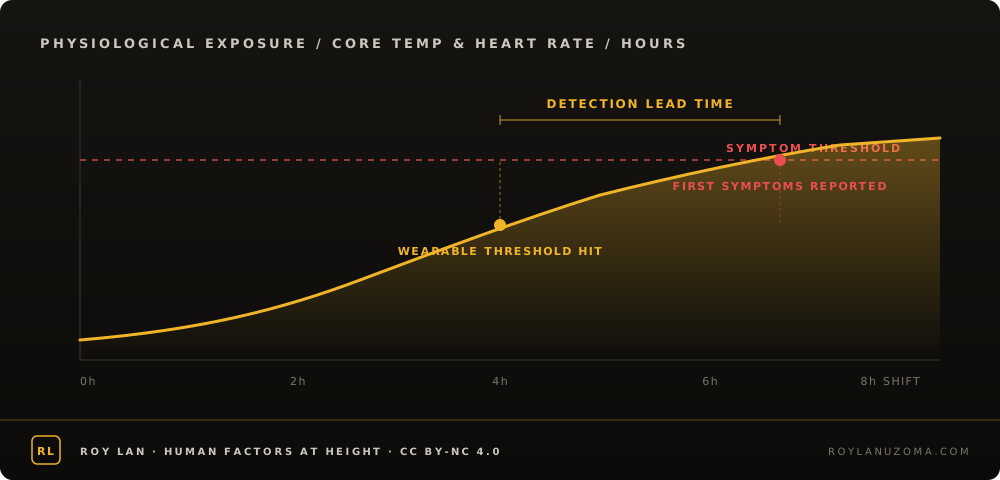
The Body Sends Signals Hours Before the Symptom Does
The most consequential thing about heat stress on a construction site is that the worker reporting symptoms is already in trouble. Symptomatic heat illness is a late-stage indicator. The physiological cascade leading to it begins hours earlier: rising core temperature, elevated sustained heart rate, declining sweat rate, narrowing pulse pressure. None of those are visible to a supervisor walking the workfront.
A worker installing rooftop ductwork on a 92-degree day will not feel notably worse at hour three than at hour one. The body is compensating. By hour five, the compensation begins to fail. By the time the worker sits down because they feel dizzy, the intervention window is no longer measured in hours. It is measured in minutes.
The hydration-and-shade model assumes the worker is the sensor. That model breaks down at the moment it matters most, when fatigue, deadline pressure, and acclimatization gaps cause the worker to misread their own physiological state.
What Wearables Make Visible on a Real Site
A heart-rate strap, a skin-temperature patch, or an arm-band sensor producing continuous data at minute-level resolution changes the supervisor's decision point. The supervisor is no longer asking does the worker look okay? They are looking at a per-crew physiological exposure trend that updates throughout the shift.
Field-validated wearables can reliably detect sustained heart rate above the worker's individual recovery threshold, core temperature drift outside the expected range for the work intensity, and inadequate recovery during scheduled breaks. Those signals do not need a clinician at the workface. They need a defined response: shift the worker to a cooler task, extend the break, or pull them off the activity.
This is where AI-assisted thresholding becomes useful. A blanket heart-rate cutoff applied to every worker is too coarse. A model that factors in individual baseline, ambient temperature, work intensity, and time on task produces alerts a supervisor can act on. The control reaches the specific worker whose exposure is rising, not the average of the crew.
The Schedule Becomes Part of the Control
The most under-applied lever in heat-illness prevention is the construction schedule itself. The same exterior installation can be sequenced differently to reduce peak afternoon exposure. Equipment-intensive work can be front-loaded into the cooler shift hours. Acclimatization periods can be planned for new crew members rather than assumed.
These are project engineering decisions, not safety decisions. They sit in the work-package development stage, where the schedule is still flexible. A project engineer who treats heat exposure as a planning input has more room to change the outcome than a safety officer trying to manage exposure after the work has started.
The data layer makes this practical. Wearable exposure trends from week one inform schedule adjustments for week two. The team that absorbed the most cumulative thermal load gets reassigned to a shaded scope. The activity that consistently produced threshold breaches gets re-sequenced to a cooler window. The hard part is feeding the data back into the planning workflow.
The planner below runs that check at the work-package stage, while the schedule is still loose enough to act on what it shows. It takes the ACGIH and NIOSH work/rest practice the field already uses for compliance and pulls it upstream into planning, where the conditions can still be changed. Run it on paper, before the crew is in the heat.
Where Programs Should Start
The mistake most teams make is trying to instrument every worker on the program at once. The result is alert fatigue, supervisor disengagement, and a pilot that gets shelved without ever producing a usable result.
The effective approach is to start with one high-exposure scope on one project. The crew working overhead exterior installation in July. The roofing crew on the south elevation. Define two physiological indicators. Set a daily review cadence with the supervisor. Run it for four weeks and see whether the team trusts the data.
Supervisor trust is the constraint. A heat alert only matters if the person running the work believes it and knows what action to take. That trust is built on a small program before it can scale to a large one.
Heat is one of the few hazards on a modern construction site that is predictable, measurable, and manageable with tools that already exist on the worker's wrist. Treating it as a planning problem gives the project team room to reduce exposure before the crew is already in the heat.
Sources
- U.S. Bureau of Labor Statistics, Census of Fatal Occupational Injuries (CFOI) — annual occupational heat-related fatality counts; construction is consistently the sector with the largest share.
- Gubernot et al., "Characterizing Occupational Heat-Related Mortality in the United States, 2000–2010" — analysis of the CFOI database; basis for the multi-year average of more than 30 deaths per year.
- OSHA National Emphasis Program — Outdoor and Indoor Heat-Related Hazards (CPL 03-00-024) — launched April 2022; revised and extended in 2026.
- OSHA, Heat Injury and Illness Prevention in Outdoor and Indoor Work Settings — rulemaking — proposed rule (2024 NPRM); not yet finalized.
- NIOSH Criteria for a Recommended Standard: Occupational Exposure to Heat and Hot Environments (2016) — physiological response, acclimatization, and recovery.
- ACGIH Threshold Limit Values (TLVs) — Heat Stress and Strain — WBGT-based occupational exposure limits and work/rest guidance.