Project Engineering Habits That Improve Mission-Critical Delivery
What Mission-Critical Actually Means
Not every large construction program carries the same consequence profile. The term gets applied broadly across the industry, but mission-critical has a specific meaning that changes how these programs need to be structured from the first work package release through commissioning handover.
Two things define it. The first is the cost structure of a failure. On standard commercial construction, a quality defect moves from inspection to non-conformance report (NCR) to resolution. The program absorbs the rework cost and the schedule impact and continues. On a mission-critical program, the same defect in the wrong location carries a different calculation entirely. A fire-rated assembly installed incorrectly in a hospital critical care wing does not just require rework. It can delay occupancy by months, trigger a regulatory review, and create liability exposure that dwarfs the construction cost of the original scope. A contamination event during fit-out of a pharmaceutical GMP cleanroom does not just require remediation. It can invalidate the full qualification sequence, adding months to a regulatory timeline that was already the critical path to product revenue. The cost of a failure is not proportional to the defect. It scales with the consequences downstream.
The second is program type. Mission-critical construction concentrates in sectors where that asymmetric consequence profile is structural, not exceptional: data centers and hyperscaler campuses, hospitals and healthcare facilities, pharmaceutical and biotech manufacturing, semiconductor fabrication plants, offshore oil and gas infrastructure, mission-critical utilities and substations. These programs share a common operating reality. The systems being installed are too interdependent and too consequential to tolerate the inspection-and-rework cycles that are normal in standard commercial work. A data center that misses a commissioning milestone by two weeks does not absorb the delay in isolation. It triggers a cascade through the owner's deployment schedule, their client commitments, and in hyperscaler environments, operational capacity that was already presold.
What Success Looks Like on These Programs
Before getting into habits, it is worth being precise about what a well-run mission-critical program actually looks like in practice: not in outcomes, but in the behaviors and controls that produce them.
Float is managed as a resource, not a buffer. On a program running the discipline correctly, when float on a critical path activity drops below a defined threshold (typically five to seven working days), it triggers a formal review and a response, not a line item in the weekly report. Float consumption rate is tracked by activity type and by responsible trade. The schedule update is a tool for managing what is coming, not documenting what already happened.
Work package readiness is confirmed before mobilization, not at mobilization. A crew arriving at a workfront that is not ready is a fully-loaded cost event. On a union MEP crew of 10 workers at $150 per hour all-in, an unproductive half-day while a workfront condition gets resolved costs roughly $7,500. On a program running 40 active work packages, unmanaged readiness failures at that rate add up in a matter of weeks.
Quality controls are embedded in the work method through hold points and Inspection and Test Plans (ITPs), not applied after the fact through NCR resolution. Hold points stop work until a specific condition is independently verified before the next activity begins. NCRs record what went wrong after it went wrong. When NCR count or NCR trending becomes the main quality signal, the team is working from lagging data. By the time the trend is visible, the exposure has already accumulated.
Escalation is a routine coordination act. Issues do not sit in a log past five to seven business days without a named owner and a required response date. At a five-business-day escalation threshold, an issue identified on a Monday reaches a senior decision by the following Monday. On a program where the affected activity carries 10 working days of float, escalation still happens with five days of buffer remaining. At a 10-day threshold, the float is gone before escalation begins. The five to seven day trigger is calibrated to the float profile of the program: on a critical path activity carrying 10 working days of float, escalation at day five still leaves a response window. At day ten, it does not.
Habit 1: The Live Constraint Log
Every project team tracks constraints in some form. The difference between a constraint log that works and one that does not is currency. A log updated on Fridays for the Monday morning report is a historical document. A log updated the moment a new constraint is identified is a coordination tool.
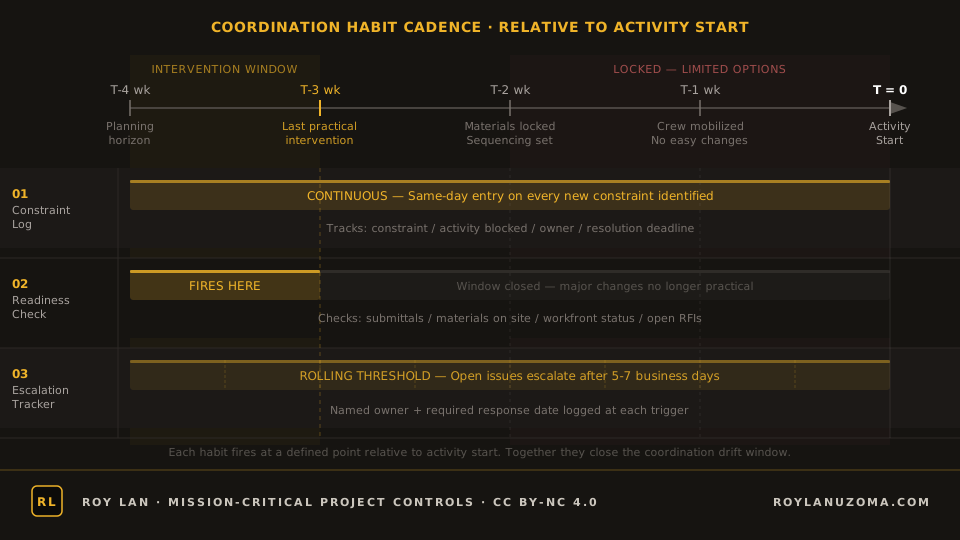
The live constraint log tracks four things for each item: the constraint, the activity it blocks, the owner responsible for resolution, and the date by which resolution is needed to avoid schedule impact. Nothing else. The format matters because a log that requires judgment calls about what to include gets applied inconsistently. Four defined fields get applied consistently because there is no ambiguity about what goes in.
The discipline is same-day entry. On a data center program where mechanical, electrical, and structural trades are running concurrent scope across multiple floors, a single unresolved handover condition between structural and MEP can consume float the schedule never had to give. At 80 percent consistency on same-day logging, you are leaving the gap that matters open. A log that is current works as an early-warning instrument. A log caught up on Monday mornings functions more as a record.
Habit 2: The Near-Term Readiness Checklist
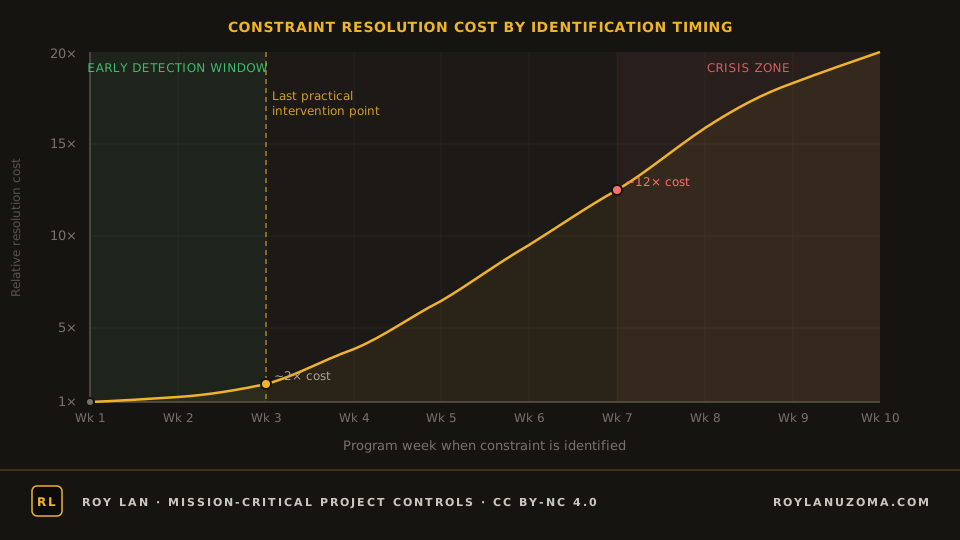
Three to four weeks out from a planned activity start is the last practical intervention point on most programs. By two weeks out, long-lead materials are locked, scaffold installation has started, and trade sequencing is committed. By one week out, the crew is mobilized. At that point, if the workfront is not ready, the options are delay or improvisation.
The near-term readiness checklist asks the same questions for every activity approaching its planned start: Are required submittals approved and issued for construction (IFC)? Are materials confirmed on site or with a delivery date inside the execution window? Is the preceding activity on track to turn over the workfront on schedule? Is there any open RFI that could affect the work method once execution starts?
A project engineer can run through these questions for a given activity in 15 minutes. On a data center or hospital expansion program, that review touches the subset of packages in the active 3-to-4-week look-ahead window, typically 10 to 15 packages at any point. That is two to three hours of structured review per week. Without it, those same answers tend to surface during execution, when the response window has already closed.
Habit 3: The Escalation Tracker
Most project teams escalate when they have no other option. An issue has sat unresolved long enough to become a schedule problem, and now it needs a senior decision under pressure. By then, it has already cost time the program could not afford.
The escalation tracker makes escalation routine rather than exceptional. Any issue open beyond a defined threshold (typically five to seven business days) surfaces on the tracker with a named owner and a required response date. The threshold is not a grace period. It is a structured decision point that routes issues requiring a different level of authority before urgency forces the call.
This removes the social friction from escalation. On programs where raising an issue reads as admitting a failure, people wait too long. When escalation is a documented step with a defined trigger, it becomes a normal coordination act, no different from a submittal log review. And it creates accountability at the senior level. A named response date in the coordination rhythm makes unresponsiveness visible before it becomes a missed milestone.
The Discipline Is the Cadence
These are not new tools. A constraint log, a readiness checklist, and an escalation tracker are standard project controls on any serious mission-critical program. What makes them perform is the cadence: the constraint log updated the day the constraint is identified, the readiness review run three to four weeks before execution on every active package in the look-ahead window, the escalation tracker reviewed on a fixed cycle before anything is urgent.
When these habits exist in name but the cadence has slipped, the same problems tend to keep surfacing late. A useful check before the next work package releases: when was the readiness review last run, and was it before or after the three-week mark? Programs where that answer is consistently after tend to be the ones managing surprises during execution.