What the Data Center Build Boom Gets Wrong About Worker Safety
The Safest-Looking Day
On a fast mission-critical program, the safest-looking day can quietly be the day the most harm is being done. No report gets filed and no supervisor sees anything go wrong, yet the exposure that will eventually put someone out of work is already building with nothing to show for it yet. I learned to distrust quiet jobsites offshore, where the conditions that hurt people rarely announced themselves while there was still time to act.
Data centers are where this is easiest to see right now. U.S. data center construction has become the fastest growing sector in the industry, running above a $50 billion annual pace and up close to 30 percent in a single year, and it packs dense mechanical and electrical scope, overlapping trades, and compressed schedules into restricted floor plates. The work itself has changed, but the safety model we run on top of it mostly has not kept up. The same pattern shows up on any high-reliability build under schedule pressure, from fabs and hospitals to power and offshore. Data centers just happen to be the loudest example.
The real gap is in what a safety program is built to notice. Some exposure is visible the instant it happens: a fall, a struck-by, an arc flash, a worker in a space they were never cleared to enter. Other exposure stays out of sight while it matters and only becomes legible after the fact, like the cumulative load of three weeks of overhead installation, the fatigue stacked across extended shifts, or the heat carried through a run of hot afternoons. Most programs are built for the first kind and effectively blind to the second, and a compressed schedule manages to widen both gaps at once, for different reasons.
Two Kinds of Exposure
Every hazard on a site sorts by one question: how long after the exposure does the harm actually show up? The answer splits the work into two categories that behave nothing alike.
Acute exposure resolves immediately. A worker falls, gets struck by a load, makes contact with a live conductor, or steps into a space that was never cleared, and the event and its consequence arrive together. A program catches these by being present at the right place in the right moment, which is why inspection, observation, and real-time enforcement are the tools built around them.
Latent exposure resolves on a delay. The mechanism is cumulative, whether it is load on a joint, fatigue across a run of long shifts, or thermal strain absorbed over days, and no single instant produces the injury. By the time it presents, the exposure that caused it is weeks in the past and usually impossible to trace. Inspection has nothing to catch, because at no observable moment is anything visibly going wrong.
A conventional safety program is built almost entirely for the first category, with its instincts, its staffing, and its metrics all assuming that harm is visible when it happens. That assumption holds well enough for falls and arc flashes, but it falls apart for the slow injuries. A compressed schedule then makes both failures worse at the same time, multiplying the workfronts the acute model has to cover while stacking the cumulative load the latent model never measures.
The Acute Gap Is a Geometry Problem
Start with the hazards that kill people fast. OSHA's Fatal Four, falls, struck-by, electrocution, and caught-in or caught-between, still account for roughly 59 percent of construction deaths, and every one of them is acute. The exposure is visible at the instant it occurs, so the entire defense rests on someone, or something, observing that instant.
On a large campus, that defense runs straight into arithmetic. Take a program with S safety officers, each able to keep meaningful watch on k active workfronts at a time, across a site running W workfronts in parallel. The share of active work under real-time observation at any moment comes out to:
c = min(1, S·k / W)
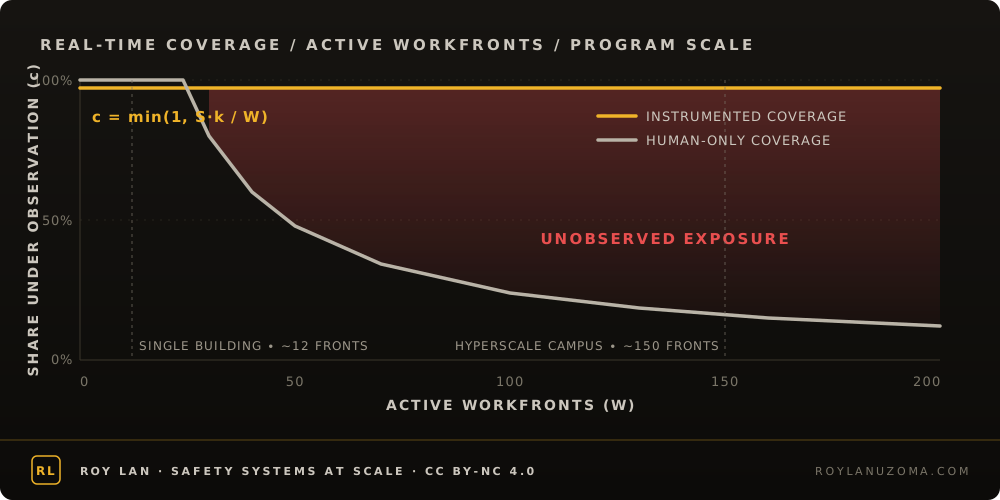
The term that moves is W. A single building might hold a dozen simultaneous workfronts, but a hyperscale campus with several buildings going up together pushes W into the hundreds, while S, the trained safety headcount, grows slowly and competes with every other program in the market for the same people. As W climbs, c collapses toward the floor.
Detection follows coverage. Borrowing the random-search result from detection theory, the probability that a transient unsafe act on a given front is actually seen follows an exponential law:
P = 1 − e−c·m
where m is how intensively each covered front is watched. The exact curve matters less than its shape, since when c is small, P is small, and no amount of diligence from an overstretched officer bends it back. It is worth sitting with what that means. The acute gap on a large campus is not a discipline problem or a training problem. It is a coverage problem, and coverage is capped by headcount divided by workfronts.
Continuous machine observation is what loosens that cap. A fixed camera or sensor assigned to a workfront holds c near one for that front however large W grows, because the coverage no longer comes out of a shared human budget. Computer-vision systems trained to flag fall-arrest gaps, missing PPE, and entry into energized or restricted zones have moved from research into live deployment, and published detection performance is now strong enough to stand up as a triage layer.
Used this way, the system works as triage. It watches the fronts no human is standing on and surfaces the highest-priority signals, so limited expert attention lands where exposure is concentrated instead of being spread thin across everything. The officer stops fighting the arithmetic and starts working with it.
The Latent Gap Is a Debt Problem
The slow injuries need a different model, and as it happens, construction engineering already owns the right one. In fatigue mechanics, a structure does not fail from a single load. It fails from the accumulation of many sub-critical loads, each leaving a small permanent mark, until the total crosses the material's tolerance. The Palmgren-Miner rule states it plainly: damage sums cycle by cycle, and failure arrives when the sum reaches one. The body under repetitive occupational load behaves much the same way, and Kumar's cumulative-load theory of musculoskeletal injury makes the parallel explicit, holding that tissue tolerance is finite, that mechanical load accumulates against it, and that the injury is simply the point where accumulated load exceeds what the tissue could take.
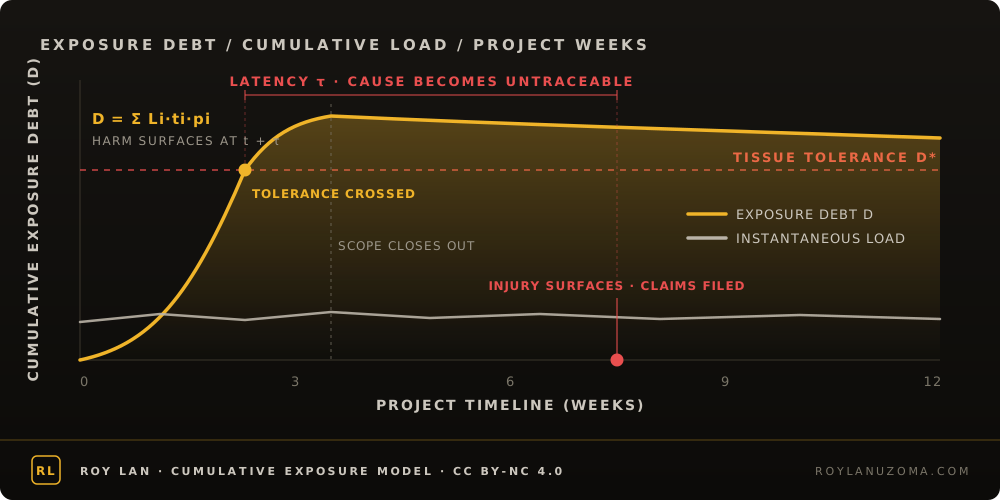
Now picture how this actually plays out on a live work package. A task cycle imposes a load L, sustained for a duration t, made more or less damaging by the posture it demands, which we can capture with a multiplier p grounded in observational scoring like REBA or RULA. Summed across the task cycles of an activity, the exposure debt is just the total of those products:
D = Σi Li · ti · piharm surfaces at t + τ
It is a deliberately simple index, and that simplicity is the point. It makes no clinical prediction. What it does is make a cumulative quantity visible before it turns into an injury, the same way a fatigue calculation surfaces accumulated structural damage before a crack ever appears.
Two features of this model carry the whole argument. The first is that D is an integral, and the real-time layer from the acute side only ever sees the instantaneous term, the load and the posture at the current moment. A worker running overhead cable tray looks about the same at hour two of week three as at hour two of week one, with nothing in the visible signal to set off an alarm. The debt lives in the area under the curve, and area under a curve cannot be read at any single instant.
The second feature is the latency. The injury does not present when D crosses tolerance; it presents at t + τ, weeks later, once the cumulative damage has expressed itself clinically. By then the activity has closed out, the crew has moved on to other scope, and the conditions that produced the debt are gone from the workfront. The claim that lands in week eight can no longer be traced back to the work package that built it in week two.
This is why the fastest program tends to carry the highest hidden risk. Schedule velocity raises the load and the hours and packs more cycles into the same window, all of which drives D up, while the real-time safety signal stays calm the entire time. The same shape governs fatigue debt across extended shift rotations and thermal debt across consecutive hot days, which is why heat, ergonomics, and fatigue keep surfacing together on compressed schedules. You cannot inspect your way out of a quantity that stays invisible until it is too late to trace, and the only place to act on D is before the work releases, while the cycles, durations, and postures are still choices on paper.
Decide Safety Upstream
Both gaps point to the same move, and it sits with project engineering more than with the safety department. The acute gap closes when coverage is designed into the workfront, and the latent gap closes when exposure debt is estimated before the scope releases. Both of those decisions belong to the work-packaging stage, where the schedule, the sequence, and the method are all still open.
For the acute side, that means treating monitoring coverage as a design input: deciding camera lines of sight, planning automated access control for the high-density commissioning windows, and naming the workfronts that will run with no human safety presence and therefore need an instrumented one. These are layout and sequencing questions, the kind you can answer cheaply in planning and pay dearly to retrofit once the building is energized.
For the latent side, it means building a structured exposure review into the work method statement before release. Identify the cycles carrying the highest load and the worst posture penalty, which usually means the overhead work, the sustained awkward positions, and the repetitive high-force handling, then estimate their contribution to D across the planned duration. Where the debt concentrates, change the method while changing it is still cheap: rotate the crews, re-sequence the cycle, add mechanical assists, or spread the exposure across more people or more days. It is the same logic the heat planner already applies to thermal exposure, generalized to cumulative load.
None of this calls for new technology. The whole shift is in timing, moving the decision upstream from the workface where safety gets policed to the planning table where the method is still soft. For a mission-critical program that is about the highest-leverage safety investment available, because it is the only point where changing the work is still cheap.
What Leadership Looks Like
As anyone running this work already knows, the boom rewards speed above almost everything else, and that speed is exactly what pulls both exposure gaps wider. That tension is not going to resolve on its own. It gets managed by people who can hold schedule, quality, and safety inside the same decision instead of trading them off one at a time.
The engineers this market is short on are the ones who move safety upstream, treating exposure as something to model and design out at the work-package stage instead of policing it on a live site. Both problems here, the geometry of coverage and the debt of cumulative load, are solvable in planning with tools that already exist. Build that habit and the program gets steadily safer without giving up any speed. On mission-critical work, where a safety failure and a schedule failure are often the same event, that is the standard worth setting now, while the buildout is still accelerating.
Sources
- U.S. Census Bureau, Construction Spending (C30) — data center construction is the fastest-growing construction sector, running above a $50 billion annual rate and up close to 30 percent year over year.
- OSHA, Commonly Used Statistics (the "Fatal Four") — falls, struck-by, electrocution, and caught-in or caught-between account for roughly 59 percent of construction worker deaths.
- B. O. Koopman, "The Theory of Search II: Target Detection," Operations Research (1956) — the exponential detection law behind the coverage model.
- Multi-Task Intelligent Monitoring of Construction Safety Based on Computer Vision, Buildings (2024) — real-time detection of PPE, posture, and zone violations on active construction sites.
- M. A. Miner, "Cumulative Damage in Fatigue," Journal of Applied Mechanics (1945) — the Palmgren-Miner linear damage rule the debt model is built on.
- S. Kumar, "Theories of Musculoskeletal Injury Causation," Ergonomics (2001) — the cumulative-load theory of musculoskeletal injury.
- Hignett & McAtamney, "Rapid Entire Body Assessment (REBA)," Applied Ergonomics (2000) — observational posture scoring for the posture multiplier.
- McAtamney & Corlett, "RULA," Applied Ergonomics (1993) — the original rapid upper-limb posture assessment method.