Figure
What the Figure Shows
Research Area 01 · Construction Decision Intelligence Lab
Site cameras and drones see hazards long before anyone files a report, but a model that cannot say how sure it is cannot be trusted with a crew. This area builds real-time detection with calibrated uncertainty and a human in the loop.
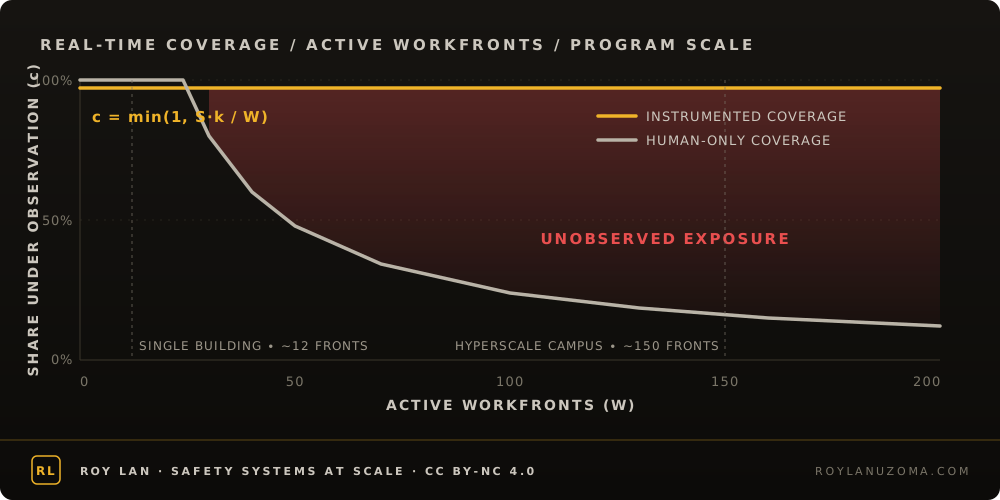
Real-time safety coverage on a large program is arithmetic: officers times the fronts each can watch, divided by the fronts running in parallel. On a hyperscale campus that ratio gets small, and the chance that a brief unsafe act is seen drops with it. Cameras and drones can hold coverage near one per front, but a model that cannot say how sure it is cannot be trusted with a crew, and a signal nobody acts on changes nothing.
Detection models trained on site imagery, UAV pose estimation, and weather-integrated risk scoring, each paired with calibrated uncertainty so the system sends low-confidence cases to a person instead of scoring them with false precision. The human review step is part of the design from the start, so the system supports the safety team rather than watching the crew.
Figure
Research → Think Tank → Field Instruments
Active work
Journal manuscript
Calibrated uncertainty for vision-based ergonomic screening, so the system routes low-confidence cases to a human instead of scoring them with false precision.
What it needs
Presented at CRC 2026, extending to site trials
Folds ambient conditions into vision-based hazard scoring so that the same posture or task reads differently at 95 degrees and 20 mph gusts than it does on a mild morning.
What it needs
Framework manuscript
A collaborative-intelligence framework for human-AI partnership in construction safety, built on the premise that monitoring workers is not the same as helping them.
What it needs
Still open
Research in motion
Get in touch
Co-investigators in computer vision, human factors, and occupational safety; contractors or industrial operators with camera or UAV access on a live site.
Propose a Collaboration Offer a Site or Dataset Student Research