Research Area 03 · Construction Decision Intelligence Lab

Decision Intelligence, Verification, and Digital Twins

A construction program is a process graph that changes every shift. This area builds algorithms that certify risk on that graph, carry provenance with every decision, and spend verification effort where uncertainty is highest.

All research areas · Research frameworks

The problem

A construction program is a process graph that changes every shift: activities, interfaces, RFIs, inspections, and handoffs, with information arriving late and unevenly. Risk gets certified once, at the plan, and then drifts. Verification effort is spread evenly across everything instead of concentrated where uncertainty is highest, and digital twins pile up data that never reaches a decision.

The approach

Algorithms that certify risk on a dynamic process graph, carry provenance with every decision so a claim can be traced back to the evidence that supported it, and adapt verification effort to where uncertainty concentrates. Alongside: a maturity model for AI-enabled safety systems, digital-twin readiness diagnostics, and RFI routing simulation, so the methods have working tools behind them.

Figure

What the Figure Shows
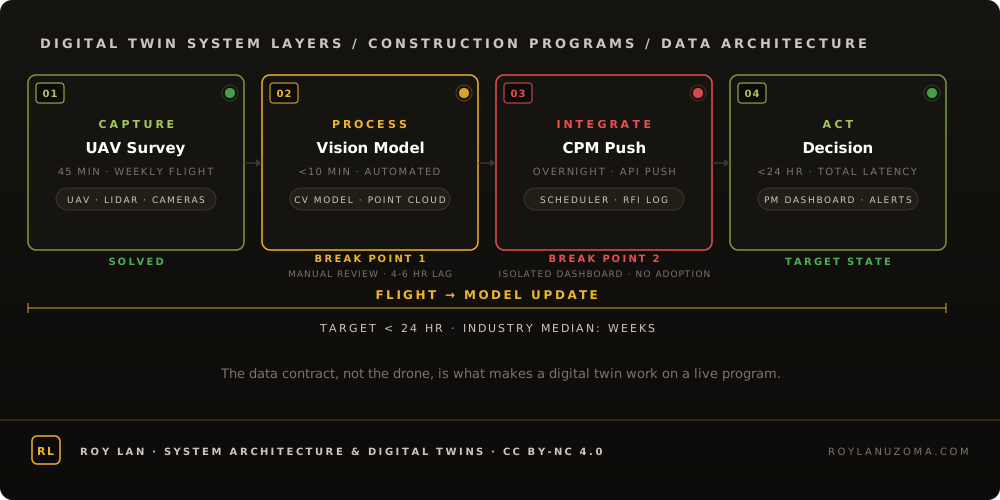
The four layers of a live twin. Capture is solved; processing and integration are where deployments break; action is where the twin either delivers or documents.

Research → Think Tank → Field Instruments

Papers, Notes, and Instruments

Papers evidence

  • Provenance-Coupled Risk Certification and Adaptive Verification for Dynamic Construction Process GraphsIN DEVELOPMENT
  • The AI-Safety Maturity Model (AI-SMM): A Multi-Dimensional Framework for Assessing and Advancing AI-Enabled Systems in ConstructionIN DEVELOPMENT
  • BIM-Digital Twin Integration for Construction Safety: Mechanisms, Maturity Pathways, and Socio-Technical ProgressionUNDER REVIEW
  • Framework for Managing and Sharing UAS-Acquired Data in Transportation Infrastructure Monitoring2026
  • A Review of Computer Vision-Based Progress Monitoring for Effective Decision Making2023
  • Safety Copilots, Not Panopticons: A Collaborative Intelligence Framework for Human-AI Partnership in ConstructionIN DEVELOPMENT

Active work

Projects in This Area

IN DEVELOPMENT

Provenance-Coupled Risk Certification and Adaptive Verification for Dynamic Construction Process Graphs

Algorithm development

A decision-making framework that models a construction program as a dynamic process graph, certifies risk at each node with a provenance trail, and concentrates verification effort where uncertainty is highest instead of spreading it evenly.

What it needs

  • Process-log and schedule data from a live project
  • A field partner willing to test the verification workflow alongside existing QA
IN DEVELOPMENT

The AI-Safety Maturity Model (AI-SMM)

Framework manuscript

A multi-dimensional way to assess where an organization's AI-enabled safety systems actually stand, from pilot theater to trusted operating loop.

What it needs

  • Contractors willing to pilot the assessment and share anonymized results

Still open

Open Problems

  1. Certification semantics for a graph whose nodes and edges change daily: what a risk certificate means once the plan it was issued against is gone.
  2. Adaptive verification policy: how to decide, cheaply and defensibly, where the next inspection hour should go.
  3. Validating the AI-Safety Maturity Model against organizations at different stages of adoption.

Research in motion

Recent in This Area

Get in touch

Work With the Lab on This Area

Co-investigators in operations research, formal methods, and machine learning; owners or general contractors willing to share process logs and schedule data from a live program.

Propose a Collaboration Offer a Site or Dataset Student Research